
Training your oxen
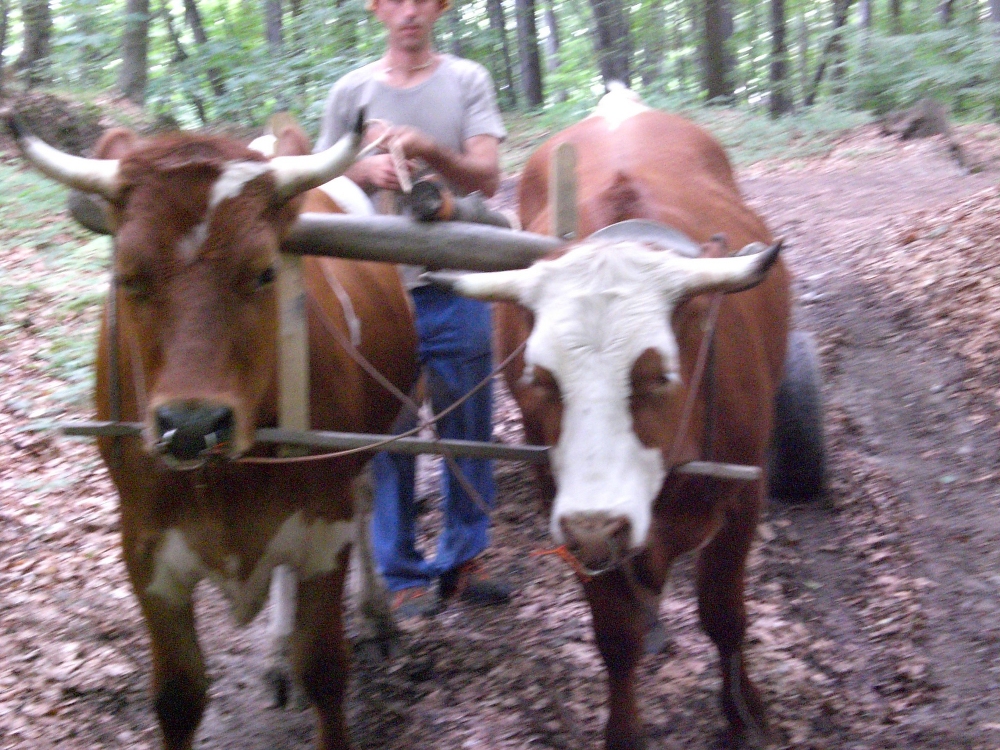
Your oxen (neutered bulls) are built for work. This is their natural contribution to life and part of their side of the interdependent relationship with mankind. Of course man has to be kind in this relationship and care for them and let them live and work to the full. Having worked with oxen for twenty years I can personally attest to the pleasant and moving experience it is to work alongside these powerful and peaceful creatures. They have muscles and a temperament just suitable for working with their trainers and drivers. I am always amazed at how they take to training and work, confirming in a real and practical way that oxen and man working side by side is a natural relationship.
When to start training. If you have the time it is good to train them when they are young as in this way you wont have to worry about being overpowered by them when they start off. If your young oxen are used to being handled in any case it will be easier. For many years I would not start training the oxen until they were about 3 years old. This choice of age was for practical considerations in that the oxen were wanted for work as they were being trained and after they were trained. As most of the farm work required some pulling of loads of one degree or another you really wanted them to have some stature and weight behind them so that a person working with them could achieve practical work results as soon as possible and some times at the same time as training. To work an ox you have to work a man/woman and it is people costs that are the biggest cost of working oxen. As they say time is money so any time you spend on training has a cost element that must be factored in. Certainly training time is an investment as you are bringing your oxen into your working team and they will help around the farm or in transportation. Still you will want to train your oxen as efficiently as possible taking into account the temperament of each ox and trainer.
In checking the old farm manuals regarding working oxen you can read that there were often teams of 6 oxen put on a yoke for ploughing. This is a lot of oxen for ploughing until you read that the starting age of the oxen for working was 2 1/2 years old. As they were not that built up then you would need 6 of them working together to do any significant work.
From my experience two full-sized oxen can plough most lands very well, you may have to switch them with another team after half a day if the work is especially tough going, just so they can rest nicely. In some old farm books from the begining of the eighteenhundreds a team of four oxen sometimes indicated an actual team of 4 oxen working together all day and at other times other ox drivers would indicate that a team of 4 oxen meant 2 oxen working in the morning and 2 working in the afternoon. Both things were going on. Indeed we can see today that most farmers have their own specific styles of cultivation and prefered tractors, similarly ox drivers of previous times and present times would use different methods for accomplishing a ploughed field
If you have the time and inclination then certainly train oxen when they are young. It will be fun and you can always find some light work that they can do if you have the mind to.
Simple steps to follow:
Get the oxen used to being tied up.
For most animal handlers this section will likely be skipped as it is something they are already aware of. For those with no experience at all will need to consider it seriously
If your oxen are already used to being tied up then you have already completed this step. For those who are training oxen that have not had any previous tying up experience then this is an essential first step.
You will need a place where the tying up can be conducted calmly, safely and securely.
If you are going to work with two oxen at the same time in the same place then it is better to secure the most dominant ox first as the junior is less likely to nudge the dominant ox. You will know your oxen and you may consider it better to secure one first in a separate area away from any other oxen.
Getting them into the yoking place with food is a very natural way to bring your ox to the where you want them. Put some thing they will like to eat in a bucket or trough and put it in the position so they are standing where you will be yoking them. You can do this a few times until they are used to it and are calm with the process.
Once they are used to coming to the feeding/yoking area the next thing is to secure them onto a rope. For me this was by looping a thick rope around their horns and tying it securely to a strong post or very strong fence. At some point they will decide they want to move on and when they find there plans foiled they may object in a variety of ways. For you as the trainer it is important that you keep them as calm as possible with firm and gentle words. After a bit of pulling they will submit to the fact that they cant get away. Once they have settled you can release them and practice again another time. Tying up cows and oxen and indeed most domesticated animals is standard practice and it is not daunting for the handler or the animals being handled. Calmness and suitable facility is all it takes.
Once you have both oxen trained to be secured to a rope then the next stage is to have them tied side by side. They may not be used to this and it is an important part of their preparedness because on a yoke they are going to be very close.
Putting on the yoke
To put on the yoke for new trainee oxen I found it easier to shorten the length of the horn ropes so there is less scope for movement. From there I would then slowly and gently rest the yoke on the kneck of one ox and hold the other end of the yoke. This way if there was some initial hesitancy and rejection by the ox you could easily remove it and then try again after it has settled. For most oxen I did not find there to be much resistance but a natural acceptance of the yoke.
Once you have rested the yoke on the kneck of one then gradually slide it over and rest kneck pieces of the yoke onto the kneck of both oxen. (I did see a friend of mine in france have his yoke on an overhead hoist which he would lower down onto them. It was done that way because his yoke was quite heavy for him to manouver and so he found this a solution to keep him working his oxen).
With the yoke resting on the knecks and the oxen accepting with little fuss you could then place the U bars under their necks and through the holes of the yoke to secure it. Sometimes you may need the help of a collegue at this time if there is some resistance from a nervous ox.
With the yoke secure you can decide to leave them standing like that for a short while and then unyoke them. Or you could, reading the temperament of the oxen go ahead with the nose ropes.
Conecting the nose rings with driving reins
By securing ropes to the noses of the oxen you are able to drive them as a person would with a team of horses. Whereas horses use a metal bar in the mouth to indicate to the horses where to go the ox driver uses a rope through the nose or a rope connected to the nose ring.
Generally I would insert the nose ring (we did this with a veterinarian) when the oxen were about a year old. this is also the time that the bulls were neutered (by a veterinarian). Consult with your local vet to decide the best time to do this.
You will need to leave some time between inserting the nose ring and then harnessing them to the nose ring.
Your oxen quickly understand that if you hold them by the nose ring they lose some of their independence and you have some control over them. Expect some of them to not immediately take to having their nose rings held without some resistance.
You could include a training regime that simply held their nose rings and did nothing strenous with it and then reward them with a carrot etc. In practice I have always persevered with harnessing the nose via the nose ring quite quickly in the training regime.
You will need to take extra precaution that you are not in harms way if they decide to swing their heads to avoid being captured by their noserings. To reduce any movement we would shorten the tethering rops so there was limited room for movement of the head. Usually once you have hold of the ring they accept the inconvenience and loss of freedom quite quickly. For those that are a bit more convinced that they want to hold onto their independence you can use a bull stick which is a stick with a hook on the end for capturing the nose ring in a safe way.
Once you have the nose riing you would thread the small linked driving chain through the ring and then secure it with a small hook back on the chain. This small linked driving chain will go up the side of the face of the ox behind the ears and behind the horns, down the other side and then threaded through the other side of the nose ring. You dont want the chain to be pulling on the nose ring at rest and you also dont want the chain to be hanging down so it goes below the ring or chin. No slack but not tight.
At the back of the neck of the oxen there will be the driving rope that is connected or permanantly looped onto the small chains. When you gently pull back on the rope the chains pull back and this pull goes to the nose ring so the ox knows you want him to stop or slow.
The nose ring and harnessing system is a way to slow and stop the oxen. By pulling on one rope to one ox and not pulling on the other rope to the other ox you will in effect slow one down or stop one and the other ox will continue. In this way you will turn. If you pull them both you will stop.
To move an ox forward you would use a goad to tap the rump of the ox so he knows you want him to move forward. You tap them both when you want them both to move forward and one when you want to keep that one moving and not the other.
These are very simple methods for driviing your oxen. In general it will be very quick between training and actual working. I have had a team of 3 to 5 year old oxen completely untrained, pulling me on a sledge within 4 days of 4, 3 hour training sessions.
Keep calm, keep confident, be kind and firm, keep you and your oxen safe at all times.
Using voice commands with the nose reins and the goad. Along with using the nose reins and the goad it is good to also use voice commands at the same time. When you want your oxen to do something like move forward or turn or stop it is helpful to let them know with your voice what you expect of them. Once you have let them know what you want then you can re-inforce it with a gentle tug or a tap. The oxen will quickly connect the voice command with what you want them to do. If you have the incling to train your oxen to respond to voice commands only then go ahead. For me in practice I would always use both and it worked well and so saw no reason to change it or upgrade it.
The general american ox driving commands of “get Up (move forward)”, “whoa (stop)”, “Haw(left)”, “Gee (right)” worked well for us as they were distinct from each other. The oxen can learn any language you select for them as long as you use the same words consistently.
Leave a Comment